
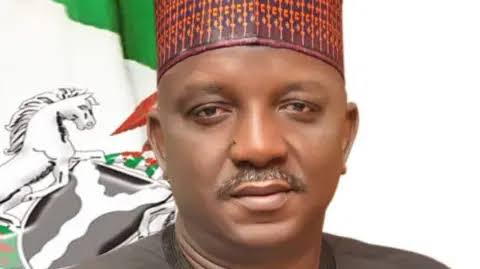
ATTAH ANTHONY writes on the travails of a former Minister of Power, Engr Saleh Mamman, who was sent to prison for corruption days after he paid N50m to vie for the position of governor of Taraba state in 2027 under the platform of the All Progressives Congress.
For many Nigerians, especially those who endured years of unstable electricity supply during the administration of former President Muhammadu Buhari, the name Engr. Saleh Mamman remains closely associated with the country’s troubled power sector.
Engr. Mamman, a former Minister of Power between 2019 and 2021, is an indigene of Taraba state, who once occupied one of the most strategic portfolios in the federal cabinet.
Today, however, the same man who once supervised the most high-profile casualties of Nigeria’s anti-corruption war, following his conviction for the alleged diversion of funds intended for key hydroelectric projects.
His journey from federal power broker to convicted public official has not only shaken political circles in Taraba State but also reignited public debate about corruption, accountability, and leadership in Nigeria.
It is against this backdrop that the Federal High Court in Abuja recently convicted the former minister on 12 counts of charges, bordering on money laundering and fraud involving N33.8 billion earmarked for the Mambilla and Zungeru hydroelectric power projects.
Justice James Omotosho of the Federal High Court, who delivered the judgment, held that the Economic and Financial Crimes Commission (EFCC) successfully proved its case against Mamman beyond a reasonable doubt.
The court subsequently sentenced him to 75 years’ imprisonment.
The judge ruled that the former minister, along with associates, allegedly diverted companies, diverted public funds intended for critical power infrastructure into private accounts and businesses.
According to Justice Omotosho, during the proceedings, he said, the defendant and his comrades in crime “did nothing but a downright harmful thing.”
“For a defendant who held a critical position such as the Ministry of Power, rather than being concerned with creating a legacy of solving the epileptic power supply in the country, the defendant began siphoning and converting monies for serious projects into private pockets.”
The judgment marked the lynch of a lengthy trial that began in July 2024 after the EFCC arraigned Mamman on allegations of conspiracy and money laundering.
During the trial, the anti-graft agency called 17 witnesses and tendered 43 exhibits to establish how billions of naira allocated for the Mambilla and Zungeru hydroelectric power projects were allegedly diverted through multiple private companies and bureau de change operators.
One of the prosecution witnesses, Abdullahi Suleman, revealed that a bureau de change his client used to convert the over N22 billion allegedly passed through 12 company accounts without any project execution.
According to him, the funds were converted into foreign currencies and transferred in accordance with instructions allegedly linked to the former minister and his associates.
Another witness, retired Colonel Abedisi Sani, owner of Sani Court Resort Limited, testified that Mamman allegedly spent N20 million from project funds on luxury accommodation.
According to the documents tendered before the court, the payments were made in instalments, through different companies over a one-year period.
Although some defence witnesses argued that Mamman made did not appear directly in certain company account documents, the court held that the evidence presented sufficiently established his involvement in the transactions.
The court further ordered the forfeiture of properties and funds linked to the fraud and directed security agencies, including Interpol, to arrest the former Minister wherever he is found.
Ironically, the conviction came at a time when Engr. Mamman had intensified consultations ahead of the 2027 governorship election in Taraba State.
Before his conviction, the former minister had formally declared his intention to contest the governorship seat, insisting Taraba State required purposeful leadership to overcome years of underdevelopment.
He had also paid N50m to obtain the governorship and expression of interest forms from the APC.
During his declaration in Jalingo, the state capital, Engr. Mamman criticised successive administrations in the state and promised to reposition Taraba through improved infrastructure, education, agriculture and security.
The Ex-Power Minister further told his supporters during the launch of his political movement that, “Taraba State was created 34 years ago, yet we are lagging behind in development.”
In a statement announcing his decision, Mamman described the move as a reflection of his commitment to serving the people of Taraba State and to responding to their aspirations.
“This step is not just a personal milestone, but a collective aspiration inspired by the hopes, yearnings, and resilience of the good people of Taraba,” he said.
He expressed appreciation to stakeholders across the state, including youths, elders, women, professionals, and traditional institutions, for their support and encouragement.
According to him, his ambition is driven by the need to provide visionary, accountable, and people-centred leadership.
Mamman noted that despite the state’s abundant natural and natural resources, challenges such as underperformance and inefficiencies have slowed development, stressing the need for a new direction.
He outlined priority areas of focus, including agriculture, education, healthcare, infrastructure, and youth empowerment, and added that his administrative would promote transparency, inclusiveness, and sustainable development.
The former minister also called on residents to unite and work collectively towards building a better future.
His declaration is expected to intensify political activities within the APC as preparations continue ahead of the next governorship election in Taraba State.
His political re-emergence had already sparked intense debate in the state’s political landscape, especially within the All Progressives Congress (APC), where many viewed him as a formidable contender due to his political influence and financial strength.
Observers believed his entry into the governorship race could significantly alter political calculations ahead of the 2027 elections.
But the conviction abruptly changed the narrative and led him into the cocoon from the EFCC and other security operatives hunt.
And what was initially projected as a political comeback soon transformed into one of the most dramatic political downfalls in recent Nigerian history.
For many residents of Taraba State, the irony surrounding the case remains difficult to ignore.
For instance, the controversial Mambilla Hydroelectric Power Project, one of the projects at the centre of the fraud allegations, is located in Taraba State, Engr. Mamman home state.
The project, conceived over four decades ago, was expected to transform electricity generation in Nigeria and stimulate economic growth in the North-East region. Yet, despite huge financial allocations over the years, the project remains stalled.
This now makes many Nigerians see the case as symbolic of the broader governance challenges confronting the country, where public officials entrusted with strategic national responsibilities are repeatedly accused of diverting funds meant for development that would benefit every citizen, including their family members.
The power sector itself remains one of Nigeria’s most troubled sectors, despite massive reforms and enormous public investments, as frequent power outages continue to affect businesses, industries, and households, with many experts arguing that corruption and policy inconsistencies have significantly undermined progress in the sector.
For political analysts, Engr. Mamman’s conviction is not only deserving, it also raises deeper questions about leadership accountability and public office.
While some Nigerians see the judgment as a strong message against corruption, others argue that the convictions alone may not be enough unless systemic reforms are implemented to prevent abuse of office.
Still, the symbolism of the former minister’s fall remains striking.
For a man who once occupied a powerful position at the centre of national governance and later sought to govern his home state, he now faces the reality of a lengthy prison sentence, which explains the dynamism and mystery of life.
Engr. Mamman’s story from the time he rose to the national limelight has quickly evolved into a cautionary tale about power, ambition and the consequences of public trust betrayal.
Observers say the fall of Engr. Saleh Mamman underscores the fragile intersection between politics, public service and accountability in Nigeria’s democracy.
Source: www.leadership.ng
Discover more from News Live Nigeria
Subscribe to get the latest posts sent to your email.